June 7, 2026
Solemnity of the Most Holy Body and Blood of Christ
Readings:
Deuteronomy 8:2-3, 14b-16a
Psalm 147:12-15, 19-20
1 Corinthians 10:16-17
John 6:51-58
Words below printed in Bold italics were sung.
Taste and see,
Taste and see the goodness of the Lord.
O taste and see,
Taste and see the goodness of the Lord,
of the Lord.
The people of Israel are about to enter the Promised Land,
when Moses addressed them for the last time.
He encourages them and us
to remember all that God had done for them,
to remember the manna in the desert,
as well as the water from the rock.
While we join Israel in giving thanks
for the goodness of the Lord,
we give thanks for another Bread from Heaven,
a different water from the rock.
We give thanks for the Bread of Life
and the Chalice of Salvation,
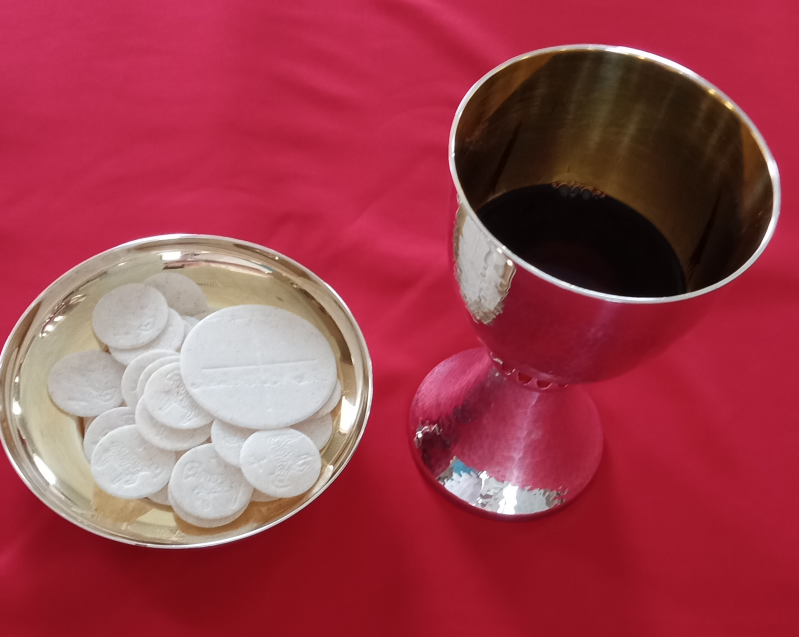
the very Body and Blood of our Savior Jesus Christ.
Taste and see,
Taste and see the goodness of the Lord.
Paul reminds the Corinthians in our second reading today,
that the cup of blessing
and the bread we break
are much more than just simple food and drink.
They had begun to take it for granted
and forgot what a wondrous thing it is
that we do when we eat this bread and drink this cup.
Paul needed to remind the Corinthians,
and to remind us, too,
that what we do at this table
is more than simply eating and drinking.
We participate in the very Body and Blood
of Christ.
We become the Body and Blood of Christ.
We become what we eat and drink.
O taste and see,
Taste and see the goodness of the Lord,
of the Lord.
In John’s gospel,
Jesus tells us
that he is the bread come down from heaven,
that whoever eats this bread will live forever.
Jesus tells us
that whoever eats his flesh
and drinks his blood
has eternal life.
He tells us that his flesh is true food
and his blood is true drink.
What we eat here
and what we drink here
is the Body and Blood of Christ,
it is the promise of eternal life,
it is a taste of heaven.
Taste and see,
Taste and see the goodness of the Lord.
Most of us genuflect or bow toward the tabernacle
when we arrive and when we depart
from this chapel
or in any other Catholic church.
We honor the presence of the Lord
in the Eucharist.
However,
when we eat his Body
and drink his Blood,
we become tabernacles.
We hold within us
the very Body and Blood of Christ.
After communion,
there is no longer only one tabernacle
in this sacred space.
There are over three hundred of them.
You and I are all sacred vessels.
You and I carry within us the presence of God.
Christ is not just back there
in a decorative box,
locked behind closed doors.
Christ is here in you and in me.
Each of us becomes the presence of Christ.
Our bodies become the Body of Christ.
The Blood of Christ flows through our veins and arteries.
We become what we eat.
We become what we drink
O taste and see,
Taste and see the goodness of the Lord,
of the Lord.
The first time I went to Guatemala,
I had studies Spanish for six weeks.
I could say a few words,
but not many.
Fr. Barry was there
and invited me to go with him
to a small town in the mountains,
to Tucurù in Alta Verapaz.
Most people in Tucurù did not speak Spanish,
and only Fr. Barry and I spoke English.
So on Sunday morning,
I decided to sit among the people,
to read from an English prayer book
while the people around me
sand and prayed in Q’echì.
Just before Mass began,
I was seated on the third bench
on the left side of the church.
It was just long enough for three people
to sit comfortably.
There were already four us when she came in.
She was wet from head to toe
and covered in mud.
In just a second or two,
I was wet and covered with mud on one side.
At communion, we exchanged the sign of peace,
each in our own language.
When she returned from communion,
her face seemed different,
more live, more joyful.
After Mass she spent a few minutes talking with the pastor,
and I wouldn’t have thought anything more of her
had he not told me her story later that day.
She had awakened at sunrise
and felt deep in her soul
that she would die that day
unless she received the Body and Blood of Christ.
So she decided to walk to the nearest church.
She lived on a coffee plantation
in an area where they celebrate the Mass
once or twice a year,
but she just couldn’t wait
until the next time a priest came to town.
It took her about three house
in the pouring rain
on steep mountain trails,
where she slipped a fell a few times along the way.
But she made it just in time for the Mass to start,
all for a small morsel of bread
and a few drops of wine.
But this morsel of bread
and these drops of wine
would save her life.
Before she even left her home,
she knew that it would take another
four hours to get back home,
since the way there was mostly downhill
and the way back mostly up hill.
That woman,
whose name I never knew,
whose language I could not understand
taught me more about what we do here today
than any theologian,
papal document,
or writing of the saints.
Her silent witness
to the power of the Eucharist
stayed with me
even to today.
Today, I remember her faith,
and I venerate her story,
as we celebrate
the Body and Blood of Christ.
Taste and see,
Taste and see the goodness of the Lord.
O taste and see,
Taste and see the goodness of the Lord,
of the Lord.